:: The articles in this series were originally
The Boeuf chronicles, Pt. 13
A tribute to the astute.
19 June 2002
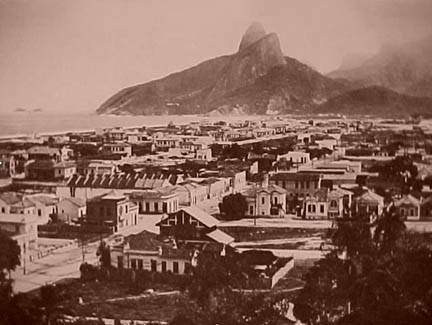
Ernesto Nazareth lived in Ipanema from 1917 to 1929, first residing at 158 Rua Doutor Vieira Souto (now Avenida Vieira Souto). In 1918, following the death of the Nazareths’ daughter Maria de Lurdes, the family moved to 12 Rua Visconde de Pirajá (then called Rua Vinte de Novembro). When this photo was taken, the street had already changed its name. At a conference convened in 1926 by the Sociedade de Cultura Artística of São Paulo, Mário de Andrade elaborated about Ernesto Nazareth’s place in Brazilian music:
In general, dance compositions base their vulgarization on imitating the popular orchestral chorus. Popular dances are in the majority sung dances. It has always been so, and the virtuoso instrumentalists of the Renaissance—when they transplanted the gigues, allemandes, and sarabandes from song to instrument—had a considerable task of creative adaptation. This adaptation consisted in extracting from the sung dances their song essence and giving them an instrumental character. They substituted the strophic theme with a melodic motif, the oral phrase with a rhythmic cell. Based on my current state of knowledge, although with reservations, I foresee that like the milonga and her successor, the Argentine tango, the maxixe’s direct origin was instrumental. However, in order to popularize itself, the maxixe, as well as the Argentine tango and the foxtrot, soon became a song form and turned into a sung dance.
This songlike aspect can be perceived even in the most admirable choreographic musicians, like John Philip Sousa or Johann Strauss, through their strophic rather than cellular norm of invention. One feels the sung melody and the oral verse. Ernesto Nazaré stands apart from this general aspect of choreographic composers by way of the almost systematic absence of vocality in his tangos. It is the motif, the melodic cell, or the rhythmic cell that serves as the foundation for his constructions. “Espalhafatoso,” for example, is constructed upon only one rhythmic cell, while “Sagaz” is entirely built on a rhythmic-melodic motif of four notes. [...]
In reality, Ernesto Nazaré is not representative of the maxixe, even less so Eduardo Souto, Sinhô, Donga, and Marcelo Tupinambá himself, who was a provincial variant of the originally carioca dance. Ernesto Nazaré could be taken for the great herald of the maxixe, that is, of the genuinely Brazilian urban dance, already free of the Hispano-African character of the habanera. [...]
Rarely except in these two tangos [“Tenebroso” and “Talisman”] does Ernesto Nazaré abandon joy. He didn’t possess that permanent sadness [Andrade calls it tristura], so typical of our people, with which Marcelo Tupinambá is intimate. It’s the mirthful and jovial stimulation of the carioca that Ernesto Nazaré represents.
Rua Visconde de Pirajá, Ipanema, in 1920 (photo: Augusto Malta)Tune No. 13: “Escovado” (1905)
‘Escovado’ in common parlance means ‘astute.’ In his book Panorama da Música Popular Brasileira, Ary Vasconcelos tells us that Nazareth was a devoted family man who generally gave his compositions titles that paid tribute to relatives. “Travêsso” was dedicated to his son Ernesto, “Marieta” and “Eulina” to his two daughters, “Dora” to his wife Teodora, “Brejeiro” to his nephew Gilberto, etc.
The tango “Escovado” (see the score) falls into the above category. The piano score in my possession dedicates the composition ao seu irmãozinho Fernando Nazareth. In his CD-ROM Ernesto Nazareth, Rei do Choro, Luiz Antônio de Almeida offers this information about the tune:
Tango first published by Casa Vieira Machado & Cia. and dedicated to Fernando, the composer’s younger brother. It became one of Nazareth’s great successes, and its principal theme was later used by the French composer Darius Milhaud in his ballet Le Boeuf sur le Toit (1919). In September 1930, accepting an invitation from Eduardo Souto, then artistic director of Odeon-Parlophon, Nazareth recorded this piece in a disc that was enthusiastically received by the press.
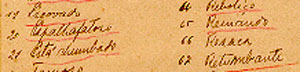
“Escovado” (no. 19 at top left) in Nazareth’s list of his tangosIn Le Boeuf sur le Toit, section A of “Escovado” appears at 6:34 min. into Louis de Froment’s recording. Having just quoted Nazareth’s “Carioca” in the violins with “Escovado” played in counterpoint by the trumpet, Milhaud now quotes “Escovado” in the violins with “Carioca” counterpointed in the flute.
It’s interesting to observe that although the two tunes were composed in different keys (“Escovado” in major, “Carioca” in minor), Milhaud adjusts the key of each counterpoint to fit that of the dominant melody. When “Carioca” is the primary theme, “Escovado” is played in minor key; when “Escovado” takes over, “Carioca” gains a major key.
Fundação Joaquim Nabuco’s database lists five recording in 78-rpm discs, four of which are undated and three are played by bands. The only dated recording is the one made by the composer himself in 1930. It was one of four sides he recorded for Odeon four years before his death (the other three were “Apanhei-te Cavaquinho,” “Nenê,” and “Turuna”). These four sides represent half of Nazareth’s entire personal output on disc.*
Autor: Ernesto Nazareth
Título: Escovado
Gênero: Tango
Intérprete: Banda do Corpo de Bombeiros
Gravadora: Columbia
Número: B-60
Autor: Ernesto Nazareth
Título: Escovado
Gênero: Tango Brasileiro
Intérprete: Ernesto Nazareth (piano)
Gravadora: Odeon
Número: 10718-B
Matriz: 3939
Data gravação: 10.09.1930
Data lançamento: Dez/1930“Escovado” has been adapted for various instruments and recorded by luminaries such as Custódio Mesquita and his Orchestra, Carolina Cardoso de Menezes and her Conjunto, Dilermando Reis, Turíbio Santos, Arthur Moreira Lima, Raphael Rabello with and without Dino Sete Cordas, Eudóxia de Barros, Joel Nascimento, Henrique Cazes & Família Violão, and many others. Egberto Gismonti adapted the tango for piano and orchestra, and Paulo Porto Alegre created a transcription for guitar quartet executed by Quaternaglia.
We’ll hear an excerpt from the 1979 recording by Turíbio Santos & Conjunto Choros do Brasil in the album Valsas e Choros. Conjunto members included Dino Sete Cordas and Raphael Rabello.
= = =
* In 1912, four sides were recorded for Casa Edison, with Pedro de Alcântara on piccolo and Nazareth on piano. They played “Odeon” and “Favorito” (both by Nazareth) “Linguagem do Coração” by Joaquim Callado, and “Choro e Poesia” by Pedro de Alcântara (the latter tune would later receive lyrics by Catulo da Paixão Cearense and become famous as “Ontem ao Luar”).
Copyright © 2002–2016 Daniella Thompson. All rights reserved.