:: The articles in this series were originally
The Boeuf chronicles, Pt. 12
An old-fashioned carioca.
17 June 2002
Postcard of Avenida Rio Branco, Rio de JaneiroErnesto Júlio de Nazareth (1863–1934) was a carioca. He was born in a modest house on the Morro do Nheco—now called Morro do Pinto—in the borough of Santo Cristo and near the Cidade Nova, birthplace of the maxixe and the samba.
In Ricardo Cravo Albin’s Dictionary of MPB, Vasco Mariz tells us that Nazareth was one of the composers of greatest importance to Brazilian culture:
His compositions, although extremely pianistic, often depicted the musical climate of serestas and choros, expressing through the piano the typical musicality of the guitar, the flute, the cavaquinho—characteristic choro instruments. This made of Nazareth the revealer of the Brazilian soul, or, more specifically, the carioca soul.
Adds Vasco Mariz in his critique:
In reality, Nazareth was an essentially carioca composer for his brejeirice and malícia, a precursor of the maxixe. [...] Nazareth portrayed with much grace and flavor the tranquil and delectable ambience of old Rio at the beginning of the 20th century, a time when everyone traveled by tram, went to the center of the city to watch a movie and have some refreshments at a teahouse in Cinelândia. He knew how to capture that romantic atmosphere of bourgeois celebrations, the processions of serenaders and ranchos carnavalescos.
Tune No. 12: “Carioca” (1913)
In his CD-ROM Ernesto Nazareth, Rei do Choro, Luiz Antonio de Almeida, the composer’s biographer, discusses the birth of “Carioca”:
A tango first published Sampaio Araújo & Cia. in 1913 and composed in rondo form with five sections: A-B-A-C-A. It was dedicated to the actor Olympio Nogueira, who at the time was very popular for his interpretation of Jesus in the play O Mártir do Calvário. Olympio had become a friend of Diniz de Nazareth, the composer’s son, because both studied the violin and had mutual acquaintances. This drew him closer to Ernesto.
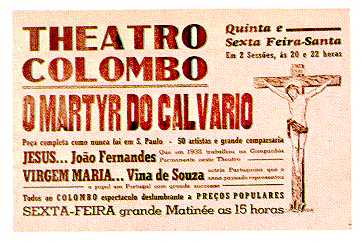
1930s playbill for “O Mártir do Calvário”O Mártir do Calvário was written by Eduardo Garrido in 1902 at the request of his friend Eduardo Victorino, who wanted a play about the passion of Christ. Both Garrido and Victorino were playwrights and theatrical producers. The play became a staple of all Brazilian theatre companies, vaudeville and circus troupes, which mounted it every Easter for over two decades. Since 1993, a modern adaptation retitled Rua da Amargura has been in the repertoire of Gabriel Vilella’s Grupo Galpão of Belo Horizonte. This version was shown on Globo TV in 2001 as Paixão Segundo Ouro Preto.
Nazareth’s dedication to Olympio Nogueira in the piano score of “Carioca” reads: “Ao talentoso e inspirado artista Olympio Nogueira.” The actor, born in 1878, would die five years later at the age of 40.
In Le Boeuf sur le Toit, section A of “Carioca” (see the score) may be heard at 6:16 min. into Louis de Froment’s recording. While the violins are playing “Carioca,” the winds play section A of Nazareth’s “Escovado” in counterpoint.
Fundação Joaquim Nabuco’s database lists this sole recording:
Autor: Ernesto Nazareth
Título: Carioca
Gênero: Tango Brasileiro
Intérprete: Heriberto Muraro (piano)
Gravadora: Victor
Número: 34689-A
Matriz: 52031
Data gravação: 29.10.1940
Data lançamento: Dez/1940Since the 1960s, a Nazareth revival has taken place, led initially by pianist Eudóxia de Barros with the release of her LP Ouro Sobre Azul (1963), in which she plays Nazareth’s compositions as he had written them, unarranged. She was followed in the ’70s by Arthur Moreira Lima, who recorded four LPs dedicated to the work of Nazareth for Discos Marcus Pereira. Most of the “Carioca” recordings date from the past quarter century or less. Among them we find piano interpretations by Moreira Lima, Dominique Cornil, Yukio Miyazaki, Eudóxia de Barros, and Marcelo Verzoni and transcriptions by guitarists: Laurindo Almeida & Charlie Byrd (1980) and Spencer Doidge (late ’90s).
This audio sample is part of Arthur Moreira Lima’s recording, to be found on the CD Brazilian Tangos & Waltzes (Pro-Arte CDG 3144).
Copyright © 2002–2016 Daniella Thompson. All rights reserved.